
Why Most Doctors Distrust AI
Jan 22, 2026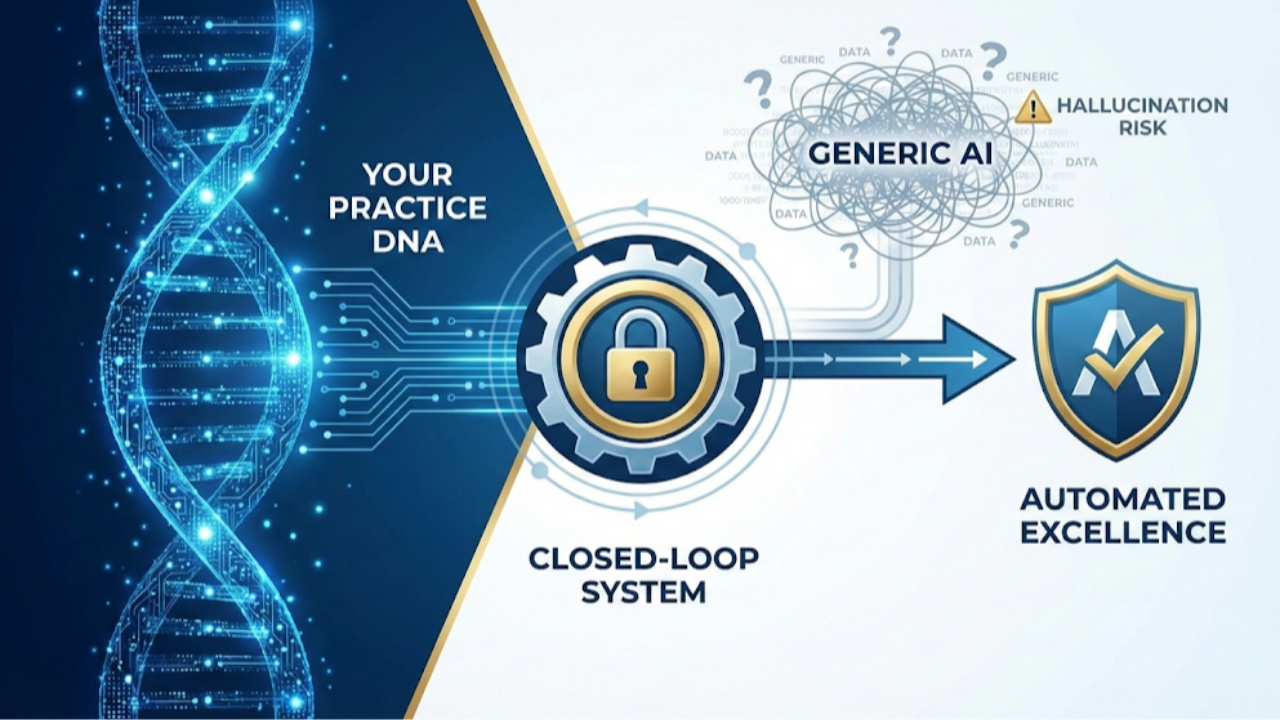
It’s Not AI Itself, It’s the Wrong AI
The promise of Artificial Intelligence in healthcare is immense: streamline operations, reduce burnout, enhance diagnostics, and free physicians to focus on what truly matters—patient care. Yet, despite the hype, a significant chasm remains between AI’s potential and its widespread adoption by physicians.
Why? It boils down to a single, powerful factor: Trust.
You trust your years of rigorous training. You trust the instincts honed over thousands of patient encounters. You trust your own clinical judgment, which is a complex blend of evidence-based medicine, empathy, and pattern recognition. You absolutely do not trust a generic algorithm, indiscriminately trained on the entire internet, to make critical decisions for your specific patients within your unique practice environment.
And frankly, you shouldn't.
The Problem with Generic AI in Clinical Settings
Generic AI, typified by large language models, is designed for breadth. It excels at summarizing vast amounts of information, drafting communications, and assisting with preliminary research. However, this breadth comes at a cost in critical fields like medicine:
-
It guesses. When faced with ambiguity, a generic AI might generate plausible but incorrect information—a phenomenon known as "hallucination." While acceptable for drafting an email, it's catastrophic for a patient’s treatment plan or a billing code.
-
It lacks specificity. It cannot account for your practice's nuanced protocols, your patient demographic's unique characteristics, or the specific regulatory environment you navigate daily.
-
It’s a black box. Often, the decision-making process of a generic AI is opaque, making it difficult to audit, verify, or explain to a peer or a patient.
According to a 2023 survey by Philips, while there's growing optimism about AI, building trust remains the biggest hurdle to adoption, particularly among healthcare professionals. Clinicians consistently express concerns about data privacy, accuracy, and the ability of AI to integrate seamlessly and safely into existing workflows [2]. Another report highlighted that while 71% of physicians believe AI will improve patient care, only a small fraction are actively integrating it into their core clinical workflows, largely due to these trust barriers [1].
Introducing DNA Core™: The Architecture of Trust
This is precisely why Synaptik Health built DNA Core™ differently. We understood that for AI to earn a physician's trust, it must mirror, not replace, the physician's expertise. Our approach pivots on a fundamental principle: a closed-loop system built exclusively on your practice's unique data.
Think of it as digitizing your practice's genetic code.
-
Ingestion of Your Protocols: We begin by meticulously ingesting your established clinical protocols, standard operating procedures, and specific treatment pathways. This isn't about generic medical textbooks; it's about your best practices.
-
Mapping Your Decision Trees: We then map your historical decision-making processes. How do you triage a specific symptom? What criteria lead to a particular diagnostic test? What are the precise steps for a follow-up? This creates a digital blueprint of your clinical intelligence.
-
Locked to Your Clinical Standards: The system is then rigorously locked to these defined standards. If your practice's "DNA" dictates that a specific symptom triggers a specific billing code, a particular triage path, or a precise patient communication, the DNA Core™ system follows that rule every single time. It does not improvise. It does not hallucinate. It executes.
This commitment to precision and specificity is paramount. Consider a study by Accenture, which found that 70% of clinical tasks could be augmented by AI, but only if the AI is truly reliable and integrated into a physician’s specific workflow [3]. Generic AI simply cannot achieve this level of integration and reliability without robust, practice-specific training.
The Difference: "Artificial Intelligence" vs. "Automated Excellence"
This is the critical distinction we champion:
-
Generic "Artificial Intelligence" often tries to replace the doctor, attempting to mimic human cognition with broad, often uncertain, outputs.
-
DNA Core™'s "Automated Excellence" ensures the doctor's proven standards are omnipresent and consistently applied across every facet of the practice. It’s about operationalizing your clinical genius.
Imagine the impact: an AI system that knows your specific patient intake forms, understands your preferred diagnostic workups, drafts patient communications in your practice's voice, and manages follow-ups exactly as you would. This isn't about generic health advice; it's about scaling your expertise.
You deserve systems that respect your genetic code—the unique, invaluable clinical intelligence you've cultivated. Demand AI solutions that amplify your standards, rather than dilute them with generic guesswork. Demand Automated Excellence.
Schedule your complementary consult with us!
Stay connected with news and updates!
Join our mailing list to receive the latest news and updates from our team.
Don't worry, your information will not be shared.
We hate SPAM. We will never sell your information, for any reason.